We’re building KNYT quietly. Early access will open before public launch. Get Early Access

Muay Thai Kicks Explained: Mechanics Behind Devastating Power

Introduction: The Most Feared Weapon in Muay Thai

In Muay Thai, punches are fast, elbows are sharp, and knees are brutal. But the weapon that truly defines the art is the kick.

Muay Thai kicks are among the most powerful strikes in combat sports. Unlike many martial arts where kicks rely mostly on speed, Muay Thai kicks combine body rotation, balance, and full-body momentum to generate devastating impact.

A properly executed Muay Thai kick does not feel like a simple strike. It feels like being hit with a baseball bat.

This power is not accidental. It comes from precise mechanics that fighters spend years mastering.

Understanding how Muay Thai kicks work reveals why they are so effective and why fighters dedicate countless hours to refining them.

At KNYT, we look at kicks not just as techniques, but as examples of perfect body coordination and explosive movement.

The Role of the Legs in Muay Thai

The legs are the strongest weapons on the human body.

They contain the largest muscle groups, including the quadriceps, hamstrings, and glutes. When these muscles work together with proper hip rotation, they can generate enormous force.

Muay Thai fighters use their legs to attack multiple targets including the opponent’s legs, ribs, arms, and head.

These kicks serve both offensive and strategic purposes. A powerful leg kick can weaken an opponent’s movement. A body kick can disrupt breathing and balance. A head kick can end the fight instantly.

Because of this versatility, kicks are one of the most important elements in a fighter’s striking arsenal.

The Muay Thai Roundhouse Kick

The most iconic kick in Muay Thai is the roundhouse kick.

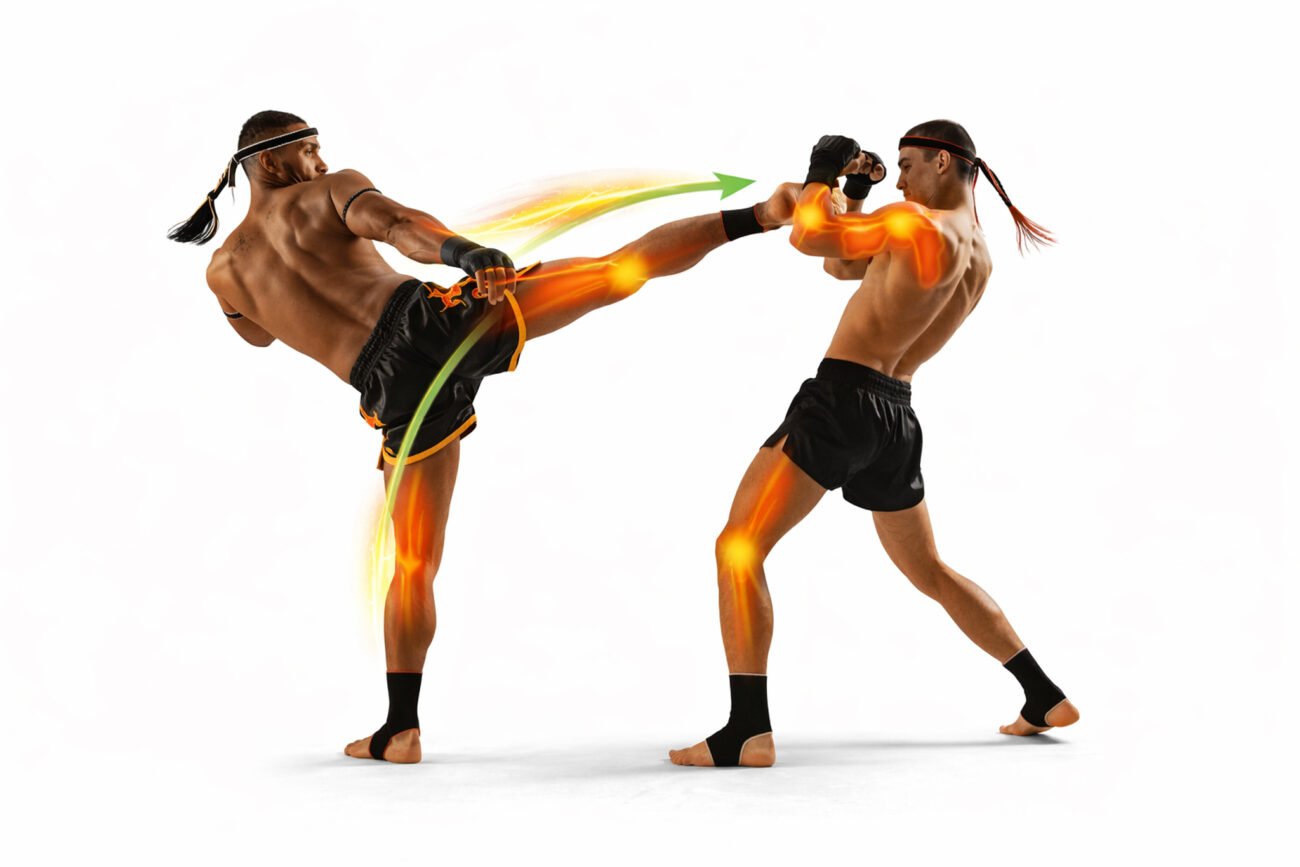
Unlike many traditional martial arts kicks that snap outward with the lower leg, the Muay Thai roundhouse uses the entire leg like a swinging baseball bat.

The movement begins with a pivot of the supporting foot. This pivot allows the hips to rotate fully toward the target.

As the hips rotate, the kicking leg swings outward in a powerful arc. The shin, rather than the foot, usually makes contact with the opponent.

This technique transfers maximum force through the hardest part of the lower leg.

The result is a strike that can cause serious damage even when partially blocked.

Hip Rotation: The Source of Power

The secret behind a powerful Muay Thai kick lies in the hips.

When the hips rotate explosively, they drive the entire leg forward with tremendous momentum.

The rotation begins from the supporting foot pivoting on the ground. This movement unlocks the hips and allows them to rotate freely.

The core muscles then stabilize the body while the kicking leg swings through the target.

Without proper hip rotation, the kick loses most of its power.

With proper rotation, the strike becomes extremely powerful.

Balance and Stability During Kicks

A powerful kick requires strong balance.

When a fighter throws a kick, they temporarily stand on one leg. If their balance is weak, they risk falling or becoming vulnerable to counterattacks.

This is why fighters train balance extensively through shadowboxing, kicking drills, and mobility exercises.

Maintaining a stable base allows fighters to deliver powerful kicks while remaining ready to defend themselves immediately after.

Balance transforms a kick from a risky movement into a controlled weapon.

Target Areas for Muay Thai Kicks

Muay Thai fighters aim their kicks at several strategic targets.

The leg kick targets the opponent’s thigh. Repeated strikes to this area can weaken the opponent’s ability to move.

The body kick targets the ribs and midsection. These strikes can knock the wind out of an opponent and disrupt their rhythm.

The head kick is one of the most dangerous techniques in combat sports. When executed correctly, it can result in immediate knockouts.

Each target requires precise timing and accuracy.

A fighter must understand when to use each type of kick depending on the opponent’s position and movement.

Shin Conditioning: Preparing the Weapon

Unlike many martial arts styles that strike with the foot, Muay Thai primarily uses the shin.

The shin bone is much stronger than the foot and allows fighters to deliver powerful strikes without risking injury.

However, the shin must be conditioned through training.

Fighters gradually strengthen their shins through heavy bag training and controlled sparring.

Over time, the bone becomes denser and more resistant to impact.

This conditioning process transforms the shin into one of the most effective striking tools in martial arts.

Training Drills for Stronger Kicks

Fighters improve their kicking technique through several training methods.

Shadowboxing allows fighters to practice the motion of kicks while maintaining balance and fluid movement.

Heavy bag training builds power and helps fighters develop proper shin contact.

Pad work with trainers improves timing, accuracy, and speed.

Repetition is essential. Fighters often perform hundreds of kicks during a single training session to build muscle memory.

These drills gradually refine both technique and power.

Defensive Awareness After Kicking

A common mistake beginners make is dropping their guard after throwing a kick.

Professional fighters remain defensively aware even while attacking.

After delivering a kick, the fighter quickly returns the leg to the ground and reestablishes their stance.

The hands remain high to protect against counterstrikes.

This discipline ensures that offensive movements do not create defensive vulnerabilities.

A good kick is not just powerful. It is controlled and balanced.

The Strategy Behind Muay Thai Kicking

Kicks are not thrown randomly in Muay Thai.

They are used strategically to control the opponent’s movement.

For example, repeated leg kicks can slow an opponent’s footwork. Once the opponent becomes less mobile, fighters can close distance and attack more aggressively.

Body kicks can force opponents to lower their guard, creating openings for punches or elbows.

This strategic use of kicks makes them one of the most versatile tools in striking combat.

The KNYT Philosophy on Power Striking

At KNYT, we believe that effective striking comes from efficiency rather than brute force.

Muay Thai kicks demonstrate how the entire body can work together to generate power.

When technique, balance, and timing align, even a simple kick becomes extremely dangerous.

This principle applies not only to combat sports but to physical training as a whole.

Efficiency creates power.

Control creates precision.

And discipline creates mastery.

Final Thoughts

Muay Thai kicks represent one of the most powerful striking techniques in martial arts.

Their effectiveness comes from the combination of hip rotation, balance, shin conditioning, and precise timing.

By training these elements consistently, fighters gradually develop kicks that are both powerful and controlled.

At KNYT, we view these techniques as examples of how the human body can achieve extraordinary performance through disciplined training.

Because the true power of a fighter does not come from strength alone.

It comes from mastering the mechanics of movement.
Muay Thai Stance Explained: The Foundation of Every Powerful Strike

Introduction: Where Every Fight Truly Begins

Every powerful strike in Muay Thai begins long before the punch or kick is thrown. It begins with the stance.

The stance is the structure that holds everything together. Without a stable stance, power collapses, balance breaks, and defense becomes weak. A fighter may have speed, strength, and determination, but without the correct stance, those attributes cannot translate into effective combat performance.

Muay Thai, widely known as the Art of Eight Limbs, integrates punches, kicks, elbows, and knees into a fluid striking system. Because fighters must transition between these weapons constantly, the stance must allow mobility, balance, and readiness for attack or defense at any moment.

For beginners, mastering the stance is the most important first step. For experienced fighters, refining the stance is a continuous process that determines how efficiently their body moves during combat.

At KNYT, we consider the stance to be the first building block of the warrior’s body. Before learning complex combinations or advanced techniques, every fighter must learn how to stand correctly.

Understanding the Muay Thai Fighting Stance

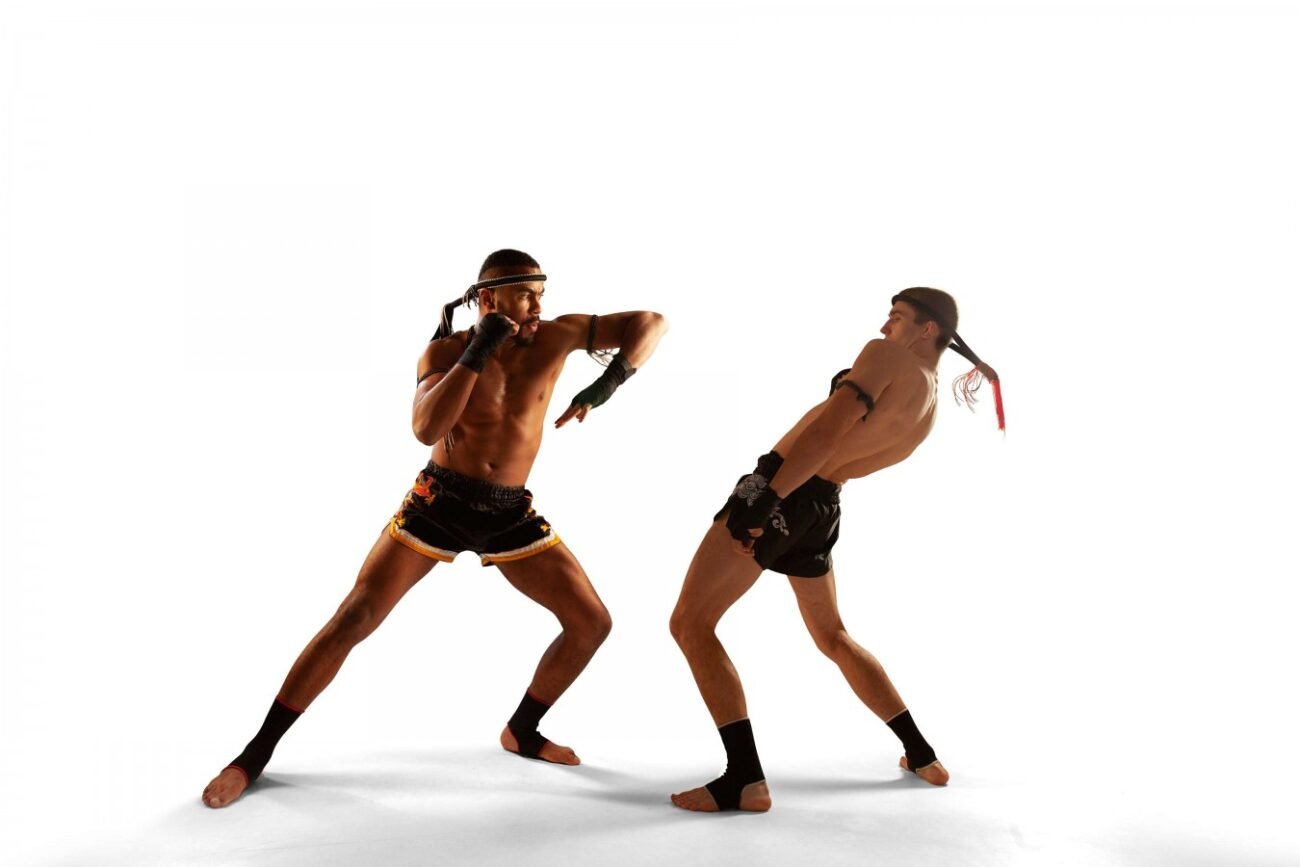
The Muay Thai stance is designed to balance mobility and stability. Unlike some combat sports where the fighter leans heavily forward or sideways, Muay Thai fighters typically maintain a slightly upright posture.

This upright structure allows the fighter to react quickly to incoming strikes while also launching powerful kicks, knees, and elbows.

The stance must achieve three critical objectives. The fighter must remain balanced at all times. The fighter must be able to move smoothly in any direction. The fighter must be able to attack or defend instantly.

These principles form the foundation of Muay Thai movement.

Foot Position: Building the Base

The feet form the base of the entire fighting structure.

For an orthodox fighter, the left foot is placed forward while the right foot stays slightly behind. The distance between the feet should be roughly shoulder width, providing stability without limiting mobility.

The front foot should point slightly inward toward the opponent while the rear foot stays angled outward. This alignment helps maintain balance during strikes and allows the hips to rotate efficiently.

A small but important detail is the rear heel. In Muay Thai, the back heel often remains slightly raised from the ground. This subtle adjustment allows the fighter to pivot quickly when throwing kicks or evading attacks.

If the feet are positioned incorrectly, every movement that follows becomes less efficient.

Weight Distribution and Balance

One of the defining characteristics of the Muay Thai stance is balanced weight distribution.

Many beginners instinctively place most of their weight on the front leg. While this may feel stable at first, it creates vulnerability to low kicks and sweeps.

The ideal distribution is roughly equal between both legs. This balanced stance allows the fighter to launch kicks from either leg and react quickly to incoming strikes.

A well-balanced stance also allows the fighter to check kicks by lifting the leg quickly to block incoming attacks.

Balance is not only about preventing falls. It is about maintaining control over every movement.

Guard Position and Defensive Awareness

The guard protects the most vulnerable targets on the body. In Muay Thai, fighters typically hold their hands high near the temples or eyebrows.

The elbows stay close to the ribs to protect the liver and body from strikes. The chin remains slightly tucked to reduce exposure to knockout punches.

Unlike boxing, where fighters rely heavily on head movement, Muay Thai defense often relies on strong guard positioning and strategic blocking.

A disciplined guard position ensures that even during intense exchanges, the fighter maintains protection.

The guard should return to its original position immediately after every strike.

Hip Alignment and Power Generation

Power in Muay Thai does not originate from the arms or legs alone. It comes from the coordinated rotation of the hips.

The stance positions the hips in a way that allows explosive rotational movement.

When a fighter throws a punch or kick, energy travels through the body in a chain beginning from the feet and traveling through the hips and core.

This chain is often called the kinetic chain.

A properly aligned stance allows the hips to rotate freely, generating significantly more striking power.

If the stance is rigid or misaligned, the fighter loses both power and efficiency.

Orthodox and Southpaw Stances

Most fighters adopt one of two primary stances.

The orthodox stance places the left foot forward and the right foot behind. This stance is common among right-handed fighters because it positions the stronger hand as the rear power punch.

The southpaw stance reverses this structure, placing the right foot forward and the left foot behind.

Left-handed fighters often prefer the southpaw stance because it positions their dominant hand for powerful rear strikes.

Both stances follow the same structural principles. The difference lies only in the orientation of the body.

Understanding both stances is important because fighters often face opponents with different orientations.

Movement Within the Stance

A good stance is not static. It allows constant movement.

Muay Thai fighters glide forward, backward, and sideways while maintaining their stance structure.

The key principle is to move without crossing the feet. Crossing the feet disrupts balance and makes the fighter vulnerable to attacks.

Instead, fighters step lightly while maintaining the same distance between their feet.

This controlled movement allows them to close distance, evade strikes, and create angles for attack.

Movement is the bridge between defense and offense.

Common Beginner Mistakes

Many beginners struggle with stance fundamentals.

One common mistake is standing too upright with locked knees. This makes movement stiff and slow.

Another mistake is leaning too far forward. Leaning forward exposes the head to counters and reduces defensive capability.

Some beginners also drop their hands during combinations. This creates dangerous openings.

The correct stance should feel relaxed yet ready. The body should feel balanced and capable of moving instantly in any direction.

Stance Training Drills

Fighters spend countless hours refining their stance.

Shadowboxing is one of the most effective ways to practice stance mechanics. By visualizing an opponent and moving around imaginary attacks, fighters develop natural movement patterns.

Mirror training is also valuable. Watching oneself in a mirror helps correct posture and guard position.

Balance drills such as standing on one leg or performing slow kicks strengthen the stabilizing muscles necessary for combat.

These drills may appear simple, but they are essential for developing a strong foundation.

The Philosophy Behind the Stance

The Muay Thai stance represents more than just a physical position.

It reflects discipline, control, and readiness.

When a fighter stands correctly, their body is aligned for both offense and defense. Their breathing becomes steady, their focus sharpens, and their movements become deliberate.

In many ways, the stance symbolizes the calm before action.

It is the moment where the fighter becomes completely present.

Final Thoughts

Every powerful strike, every successful defense, and every winning exchange begins with a stance.

Mastering the Muay Thai stance transforms the way a fighter moves. It builds balance, increases striking efficiency, and enhances defensive awareness.

For beginners, the stance is the first lesson.

For experienced fighters, it remains a constant area of refinement.

At KNYT, we believe that great fighters are not defined by how hard they strike, but by how well they control their body in every moment.

And that control always begins with the stance.

The Warrior Stance: Mastering The Muay Thai Fighting Position

(KNYT Academy — Fight Science Series)

Introduction

Every powerful fighter in history shares one fundamental secret.

Before the punches…
Before the kicks…
Before the knockouts…

There is the stance.

The stance is the foundation of combat.

Without a proper stance:

  • strikes lose power
  • balance collapses
  • defense breaks down
  • reaction speed drops

In Muay Thai — often called The Art of Eight Limbs — the stance is even more important.

Unlike many martial arts that rely primarily on hands or kicks, Muay Thai integrates:

• punches
• kicks
• elbows
• knees

All flowing from a single balanced position.

The stance determines:

  • your power
  • your speed
  • your stability
  • your defensive capability

In this guide from KNYT, we break down the true Muay Thai stance, how elite fighters use it, and how beginners can master it.

The Philosophy Behind The Muay Thai Stance

Unlike boxing, Muay Thai is not built purely around punching.

It is a complete striking system.

This means the stance must allow:

• explosive kicks
• strong checks
• quick knees
• elbow strikes
• clinch control

A good stance provides three critical advantages.

1 Stability

You must remain balanced even while throwing powerful kicks.

2 Mobility

Fighters must move smoothly around opponents.

3 Defense

The stance naturally protects vital targets.

When done correctly, the stance becomes second nature, allowing the fighter to react instinctively.

Step 1 — Foot Position

Your feet create the base of your entire fighting structure.

For an orthodox fighter:

• left foot forward
• right foot back
• feet shoulder width apart

The back heel should remain slightly raised.

This allows:

• quick kicks
• explosive movement
• faster pivots

Step 2 — Weight Distribution

Proper weight distribution is critical.

The ideal ratio:

50% front leg
50% back leg

This balance allows fighters to:

• kick with either leg
• defend quickly
• move in any direction

If weight is too forward → vulnerable to sweeps.

If weight is too backward → weak punches.

Step 3 — Guard Position

Hands must protect the head.

Key points:

• hands near eyebrows
• elbows tight to ribs
• chin tucked slightly down

This protects:

  • jaw
  • temple
  • liver
  • solar plexus

Step 4 — Hip Alignment

The hips must remain slightly turned.

This allows quick rotation for:

• roundhouse kicks
• knees
• hooks

Hip mobility generates real striking power.

The Most Common Beginner Mistakes

Even experienced gym trainees often perform Muay Thai stance incorrectly.

Here are the most common errors.

Standing Too Square

Beginners often face opponents directly.

This exposes:

• ribs
• liver
• stomach

The body should remain slightly angled.

Too Much Weight On The Front Leg

This makes the fighter vulnerable to:

• low kicks
• sweeps
• push kicks

Balanced weight is essential.

Hands Too Low

Dropping hands is the fastest way to get knocked out.

Your guard must always return to position.

How Fighters Train Their Stance

Professional fighters spend months refining their stance.

Training drills include:

• shadowboxing
• mirror training
• balance drills
• footwork drills

Shadowboxing is especially powerful.

It allows fighters to practice:

  • movement
  • guard
  • balance
  • rhythm

without an opponent.

The Role Of Stance In Knockout Power

Power in striking does not come from arms.

It comes from the ground.

The stance allows fighters to transfer energy from:

feet → legs → hips → shoulders → fists.

This is called the kinetic chain.

If the stance is weak, the chain breaks.

Defensive Power Of The Stance

The stance also acts as a defensive shield.

From the correct stance fighters can easily:

• check kicks
• block punches
• move out of range
• counter attack

Defense and offense are built from the same position.

The Evolution Of Muay Thai Stances

Traditional Muay Thai used a more upright stance.

Modern fighters adapt slightly depending on style.

For example:

Aggressive fighters:

• slightly heavier front leg
• closer distance

Counter fighters:

• lighter stance
• more mobility

But the core principles remain identical.

Why Every Fighter Must Master The Stance

A great stance gives fighters:

• balance
• power
• speed
• defense
• endurance

Without it, even the strongest athlete will struggle.

But once mastered, the stance becomes automatic.

It becomes the fighter’s natural posture.

Final Thoughts

Every journey in martial arts begins the same way.

Not with a punch.

Not with a kick.

But with how you stand.

Master the stance, and everything else becomes easier.

At KNYT, we believe fitness is not just about strength.

It is about discipline, awareness, and mastery of the body.

And every master begins with the fundamentals.

Back to Top

Search For Products

Product has been added to your cart
Compare (0)