
Introduction: The Punch That Ends Fights
In the world of combat sports, there are many striking techniques that fighters rely on. Hooks can break through defenses, uppercuts can catch opponents off guard, and kicks can deliver devastating damage. But among all punches used in striking combat, one technique stands above the rest when it comes to raw destructive potential.
That punch is the cross.
The cross punch, often called the rear straight punch, is one of the most powerful weapons in boxing, Muay Thai, kickboxing, and mixed martial arts. It travels directly from the fighter’s rear hand toward the opponent with tremendous speed and force. When executed correctly, it can end fights instantly.
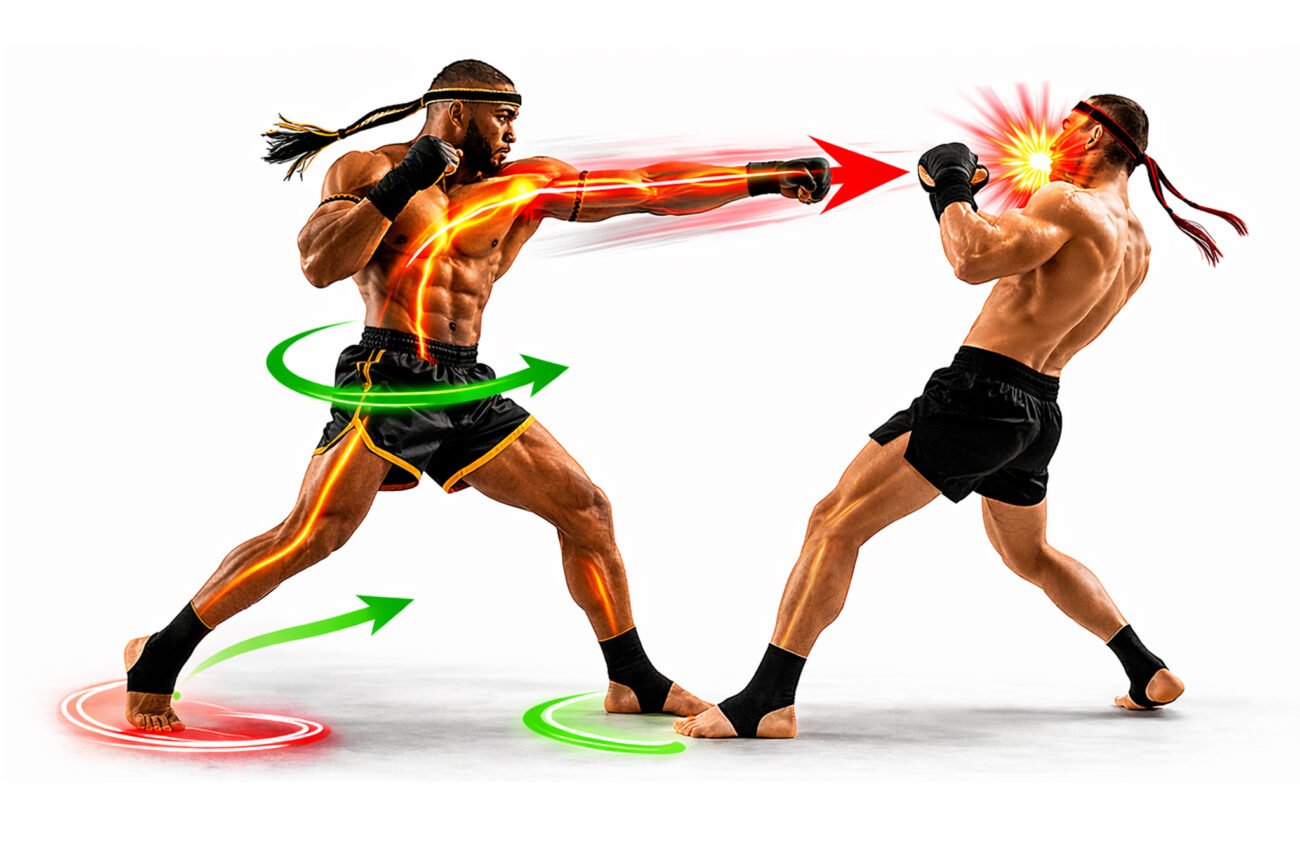
Unlike the jab, which is primarily used to control distance and disrupt rhythm, the cross is designed to deliver maximum power. It uses the entire body to generate explosive force that travels from the ground through the legs, hips, core, shoulders, and finally into the fist.
The effectiveness of the cross punch does not come from arm strength alone. It is the result of precise mechanics, body rotation, timing, and coordination.
At KNYT, we view the cross punch as one of the clearest examples of how proper biomechanics can transform a simple movement into a devastating weapon.
Understanding how to throw the cross correctly is a fundamental step toward developing powerful striking ability.
Understanding the Mechanics of the Cross Punch
The cross punch is thrown from the rear hand. For an orthodox fighter, this means the right hand. For a southpaw fighter, the cross is thrown with the left hand.
The punch travels straight toward the target in a direct line, making it both efficient and difficult to defend against.
What makes the cross so powerful is the way it engages the entire body.
The movement begins with the rear foot pushing against the ground. This push creates the initial force that drives the body forward.
The hips then rotate explosively toward the opponent. This rotation transfers energy through the core muscles and into the upper body.
As the torso rotates, the shoulder drives forward while the arm extends toward the target.
The fist rotates slightly at the moment of impact, allowing the knuckles to connect cleanly.
This chain of movement allows the punch to generate maximum force.
The Role of the Kinetic Chain
In striking mechanics, the concept of the kinetic chain is extremely important.
The kinetic chain refers to the sequence of body movements that generate and transfer power during a strike.
In the cross punch, the kinetic chain begins with the feet pushing against the ground.
The legs then drive the hips forward while the core muscles stabilize the torso.
The shoulders and arms finally deliver the punch to the target.
If any part of this chain is weak or poorly timed, the punch loses significant power.
This is why fighters train their entire body rather than focusing only on arm strength.
When the kinetic chain works efficiently, even a relatively small fighter can deliver tremendous force.
Foot Position and Balance
Proper foot positioning is essential for throwing a powerful cross.
The rear foot plays a crucial role in generating power.
As the punch begins, the fighter pivots slightly on the rear foot while rotating the hips toward the opponent.
This pivot allows the body to rotate freely without losing balance.
The front foot remains stable, acting as an anchor that supports the body during the strike.
Maintaining balance is critical because an unbalanced punch leaves the fighter vulnerable to counterattacks.
Elite fighters can deliver powerful crosses while remaining perfectly balanced and ready to defend.
Hip Rotation and Power Generation
One of the biggest contributors to punching power is hip rotation.
When the hips rotate quickly and forcefully, they generate enormous momentum.
This rotational force travels upward through the torso and into the shoulders and arms.
The faster and more controlled the hip rotation, the more power the punch delivers.
Many beginners attempt to punch using only their arms. This approach produces weak strikes and wastes energy.
Experienced fighters understand that the hips are the true engine behind powerful punches.
By training hip rotation and core stability, fighters can dramatically increase their striking power.
Shoulder Alignment and Protection
During the cross punch, the rear shoulder moves forward as the arm extends.
At the same time, the lead shoulder rises slightly to protect the chin.
This shoulder positioning provides natural defensive coverage while attacking.
Keeping the chin tucked behind the lead shoulder reduces the risk of counter punches.
Proper shoulder alignment also helps maintain balance and stability throughout the movement.
These small details may appear subtle, but they are essential for effective striking technique.
Accuracy and Target Selection
Power alone does not guarantee success in combat sports.
Accuracy plays an equally important role.
The cross punch is often aimed at vulnerable areas such as the chin, jaw, or temple.
These areas are particularly sensitive because strikes there can disrupt the brain’s equilibrium.
A clean cross punch to the chin can cause immediate knockouts.
Body shots are also effective targets. A well placed cross to the solar plexus or liver can severely weaken an opponent.
Fighters train extensively to improve accuracy so that their punches land precisely where they are most effective.
Timing the Cross Punch
Timing is one of the most important elements of effective striking.
A powerful cross thrown at the wrong moment may miss entirely.
Elite fighters often use the cross punch as a counterattack.
For example, when an opponent throws a jab, the fighter may slip slightly to the side and immediately deliver a cross down the center.
Because the opponent is already moving forward, the impact becomes even stronger.
This principle is known as counter striking, and it can produce some of the most dramatic knockouts in combat sports.
Combinations That Use the Cross
The cross punch is rarely used alone.
It is most effective when combined with other strikes.
One of the most famous combinations in boxing is the jab-cross combination.
The jab disrupts the opponent’s guard and creates an opening for the cross.
Another common combination is jab-cross-hook, where the cross sets up a powerful hook.
In Muay Thai and kickboxing, fighters often follow the cross with a roundhouse kick or knee strike.
These combinations allow fighters to maintain pressure and create continuous offensive momentum.
Training Drills to Improve the Cross Punch
Fighters develop their cross punch through consistent training and repetition.
Shadowboxing allows fighters to practice technique and body mechanics without resistance.
Heavy bag training helps build power and endurance while refining striking accuracy.
Pad work with trainers improves timing and reaction speed.
Strength and conditioning exercises such as medicine ball throws and rotational core workouts enhance the muscles involved in punching power.
Over time, these training methods create muscle memory that allows fighters to deliver powerful punches instinctively.
Common Mistakes Beginners Make
Many beginners struggle with cross punch technique because they focus too much on arm movement.
Punching only with the arm produces weak strikes.
Another common mistake is leaning too far forward during the punch.
Leaning disrupts balance and makes it difficult to recover quickly.
Some fighters also drop their lead hand while throwing the cross, leaving their face exposed.
Correcting these mistakes requires careful attention to technique and consistent practice.
The Psychology of Power Punching
Throwing powerful punches requires confidence and composure.
Hesitation can reduce the effectiveness of a strike.
Fighters train mentally to remain calm and focused under pressure.
Visualization techniques are often used to mentally rehearse perfect strikes before stepping into the ring.
This mental preparation allows fighters to execute techniques with precision and confidence.
The psychological aspect of striking is just as important as the physical mechanics.
The KNYT Philosophy of Efficient Power
At KNYT, we believe that true power comes from efficiency rather than brute strength.
The cross punch demonstrates how the human body can generate incredible force when movement is coordinated properly.
By combining balance, rotation, timing, and accuracy, fighters transform a simple straight punch into one of the most dangerous techniques in combat sports.
This principle applies to all aspects of athletic performance.
Efficiency of movement allows the body to perform at its highest potential.
Final Thoughts
The cross punch is one of the most powerful and effective strikes in combat sports.
Its strength comes from the coordinated movement of the entire body, from the feet pushing against the ground to the fist connecting with the target.
Mastering the cross punch requires patience, repetition, and careful attention to technique.
But once perfected, it becomes a devastating weapon capable of changing the outcome of a fight in a single moment.
At KNYT, we believe that understanding the mechanics behind powerful techniques helps athletes train smarter and perform better.
Because in the end, true strength is not just about force.
It is about mastering the movement that creates it.
Leave a comment